



The Ultimate Guide to CPP Film in Flexible Packaging: Specs, Processing, and Key Selection Metrics
Release time: 2026-05-20
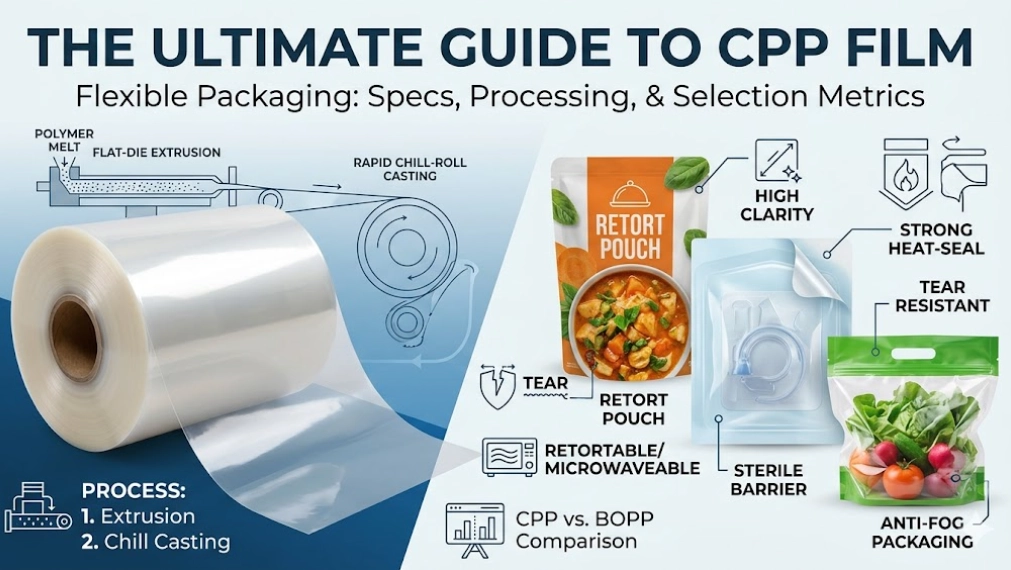
A CPP film (Cast Polypropylene Film) is an unoriented, high-clarity polymer substrate manufactured through a specialized flat-die extrusion and rapid chill-roll casting process. Unlike its biaxially oriented counterpart (BOPP), this versatile material retains excellent heat-sealability, high tear resistance, and exceptional optical properties. Serving as the critical sealing layer in multi-layer laminated structures, it plays an indispensable role in preserving freshness, extending shelf life, and ensuring structural integrity across food, medical, and consumer packaging industries.
The Material Science and Extrusion Physics behind Casting
The production of high-performance cast film relies on precise thermodynamic control and rapid polymer crystallization quenching. During fabrication, polypropylene resin pellets are melted and pushed through a flat T-slot die at temperatures hovering around 230°C to 250°C. The molten web is immediately pinned against a highly polished, water-cooled chrome chill roll rotating at high speeds.
On a molecular level, this rapid cooling or “quenching” prevents the polymer chains from organizing into large, light-scattering crystalline structures known as spherulites. By locking the material into a predominantly amorphous state, the film achieves its signature high gloss and transparency. Because the film is drawn only in the machine direction without secondary transverse stretching, the polymer molecules remain relaxed. This lack of molecular orientation yields isotropic physical properties and leaves the polymer chains free to melt and fuse together during subsequent heat-sealing processes.
Core Technical Advantages of Cast Polypropylene
Choosing a premium cast polypropylene film provides distinct mechanical upgrades over standard polyethylene (PE) alternatives, especially in demanding high-temperature environments. Production line metrics indicate that upgrading to high-tier cast substrates can reduce seal-failure rates in automated form-fill-seal (FFS) machinery by up to 18%.
- Exceptional Heat-Seal Strength: The relaxed molecular structure allows the film to form hermetic seals at lower threshold energy levels, achieving a robust seal strength often exceeding 15 N/15 mm.
- Superior Thermal Stability: With a melting point (≈165°C), it easily withstands demanding thermal treatments like pasteurization and retort sterilization without wrinkling or delaminating.
- Excellent Moisture and Aroma Barrier: The inherent hydrophobic nature of polypropylene provides a low water vapor transmission rate (WVTR), effectively locking in moisture and volatile flavor compounds.
Manufacturing Standards and Packaging Applications
Engineering a dependable flexible packaging film requires rigorous control over gauge uniformity and surface tension. Modern cast lines utilize automatic beta-gauge scanners to monitor thickness profiles in real-time, adjusting die bolts via thermal expansion to keep gauge variations within a strict ±2% window. To guarantee successful downstream converting, the film undergoes online corona discharge treatment, boosting the surface energy to a minimum of 38 dynes/cm to ensure strong ink and adhesive anchorage.
Factory operators balance the chill roll temperature matrix carefully; running the roll too cold causes condensation issues, while running it too hot induces sticking and compromises optical haze metrics.
These adaptable characteristics make the material ideal for multiple high-performance sectors:
- Retort and Stand-up Pouches: Acting as the internal sealant layer for pet food and ready-to-eat meals that undergo rigorous autoclave sterilization.
- Bakery and Produce Packaging: Providing high-clarity anti-fog wraps that showcase product freshness while preventing moisture accumulation.
- Medical Device Packaging: Ensuring clean-peel performance and sterile barrier maintenance for syringes, gloves, and surgical tools.
CPP Film vs. BOPP Film: Understanding the Differences
When engineering a laminated packaging structure, selecting the proper polypropylene variant requires balancing mechanical rigidity against sealing performance.
| Performance Attribute | CPP (Cast Polypropylene) | BOPP (Biaxial Oriented Polypropylene) |
| Molecular Alignment | Non-oriented (Amorphous/Random) | Biaxially stretched (Highly oriented) |
| Primary Structural Role | Inner heat-sealing & puncture-resistant layer | Outer printing, laminating, & tension layer |
| Optical Haze (%) | Very low (typically < 2.5% for premium grades) | Extremely low (typically < 1.5%) |
| Elongation at Break | High (> 400% in both directions; flexible) | Low (< 150%; rigid and brittle under tension) |
| Heat Sealability | Excellent (Inherent sealing capabilities) | Poor (Requires co-extruded seal layers or coatings) |
FAQ: Resolving Critical Packaging
What is the typical heat-sealing temperature window for CPP films?
Standard homopolymer variants generally begin sealing around 135°C to 140°C, whereas advanced random copolymer modifications lower the initiation temperature down to 120°C. For optimal high-speed line performance, operators usually set jaw temperatures between 150°C and 170°C, depending on dwell time and machine pressure.
Can this material be used safely in microwaveable packaging?
Yes, due to its high melting threshold and excellent thermal stability, specially formulated grades are widely used for microwave reheat applications. They do not leach harmful plasticizers and retain their structural form well past the boiling point of water, unlike standard polyethylene options.
How does storage humidity affect the film’s surface treatment?
Polypropylene itself is highly resistant to moisture absorption; however, prolonged storage in high-humidity environments can accelerate “corona decay.” This breakdown occurs when migrating slip additives bloom to the surface, lowering the effective surface tension and potentially causing ink adhesion issues during printing or lamination.